| Lesson 7 | Storyboard development |
| Objective | Develop a Storyboard to outline your Plans |
Develop a Storyboard to outline your Plans
Whether you are building a site from the ground up, creating a site for an existing company, or planning a significant addition, you should use a technique referred to as "storyboarding" before you begin coding and implementing your site.
Storyboarding is the process of creating an overall plan showing structure, sequence, and connections of each logical step, as well as the details surrounding Web pages or nodes. Such details include how each aspect of your Web site maps to your business goals.
Storyboarding is the process of creating an overall plan showing structure, sequence, and connections of each logical step, as well as the details surrounding Web pages or nodes. Such details include how each aspect of your Web site maps to your business goals.
Front-end plans
As far as the front end is concerned, three common types of storyboards are:
- Linear
- Hierarchical
- Random These are described in the SlideShow below.
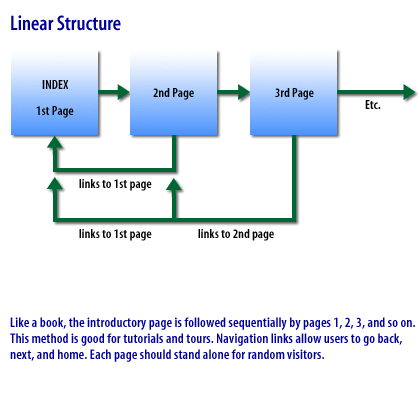
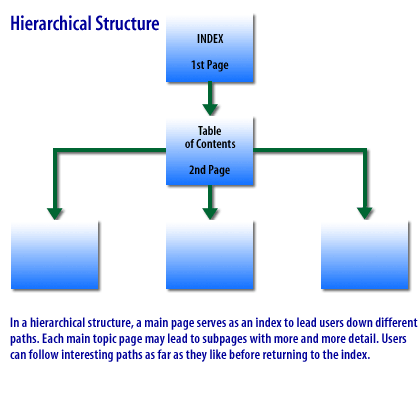
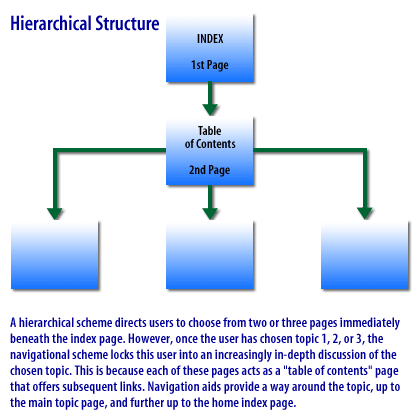
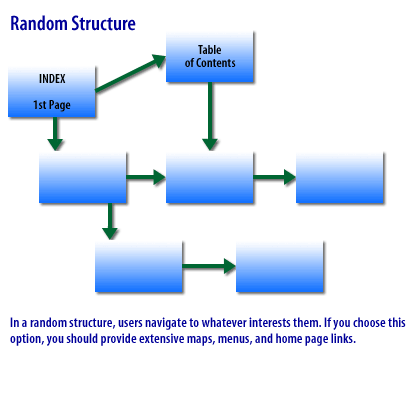
Story Board Development Types
Dropshipping
In a random storyboard, the main page links to other pages, loosely related, but arranged in no specific order.
When using a random structure, provide links to guide users to various places in your site. There is a fine line between a
When using a random structure, provide links to guide users to various places in your site. There is a fine line between a
- well-constructed random area of a Web page and a site area that is merely a
- hodgepodge of poorly thought-out pages.
Back-end concerns
During the storyboard phase, you may also be planning your architecture and functional needs.
To do this you must determine what servers, programs, and hardware will be required for your site. If you plan on having a login area, you need to provide a database, as well as some way to connect to it.
This demands the use of a common gateway interface (CGI) solution. Server side scripting options include:
- Active Server Pages (ASP)/ ASP.NET 4.5
- Perl (Practical extraction Report Language)/5.18.0
- (JSP) - Java Server Pages
- Cold Fusion
- PHP5
- Oracle 11/G/12C
- Microsoft SQL Server 2012/2016
- IBM DB2
- MySQL V
If you are planning a gaming site, for example, you will likely require higher bandwidth than other sites. If you wish to provide live video, then you will need streaming audio server software. You will learn more about physical site design and hardware issues in a later module.
